

A truly free market seems elusive these days. Anyone familiar with markets has to admit that manipulation takes place on many levels. And, while our discussion usually focuses on manipulation in precious metals, the fact remains that various types of manipulation are taking place in every market.
On one hand, who can blame them? For instance, if you could figure out a way to spend $100,000 today in such a manner that the markets would move in your favor, providing a return of $150,000 tomorrow, wouldn’t you do it? This, of course, is one of the dangers of stocks that trade in low volumes. As soon as there’s a growth in interest, they often rise far above their true value. However, there is manipulation within the markets that’s far more technical, lightning fast and even insidious than movements caused by high-volume influences.
Years ago programmers began to toy with programs that monitored various indexes and specific stocks. As the programs became more powerful, they began tracking micro-second movements. Of course, such programs not only tracked, but entered and exited markets to the advantage of those who owned the programs. These people are not the retirement investor or even home-based day-trader, but the large Wall Street financial institutions that were able to attract mathematical geniuses capable of developing such programming.
These programs, sometimes called algobots, bots or HFT (high-frequency trading) programs, give an edge to these institutions that the normal investor can’t even dream of. Try to imagine being able to buy 100,000 shares of Amazon, only to sell the same shares one-tenth of a second later at one penny per share profit. Now imagine being able to do that a few times per second, every minute of every trading day. Don’t stop there. Now imagine being able to do that with every major stock in every major index in the world, every day.
Now you may be just at the cusp of understanding the significance of these algobots. “So what?” you might ask. After all these tiny movements don’t really affect the long-term investor, right? I mean, if I own Wal-Mart for the dividends as much as, or more than, the growth of the stock, does this really affect me?
The answer is, yes, absolutely. It may help your portfolio, if the algobots are in your favor. But, over the long run, the result is a market that becomes priced in HFT terms rather than based on underlying value. As I discussed with a friend recently, when Facebook launched into the stock market at a 100 P/E ratio, it was simply ridiculous. That’s way overpriced. But he responded that he didn’t really care. All he cared about was whether or not he could accurately trade the movement, regardless of the value.
In other words, if he could invest correctly and the stocks went to a 500 P/E ratio, he’d be tickled to death, even though he knew the company wasn’t worth that. And if he bought puts and it dropped to a 10 P/E ratio, he’d be just as tickled, because he’d be cashing in. The value meant nothing to him. All that he cared about was that he could take profits from the movements.
Algobot infiltration into major markets has grown exponentially over the past five years. In fact, Nanex has provided us with a chart that reveals this growth from 2007 to February 2012. We encourage you to take a minute and watch how it plays out. The dates roll on the bottom left with the bottom scale representing the time of day in the markets.
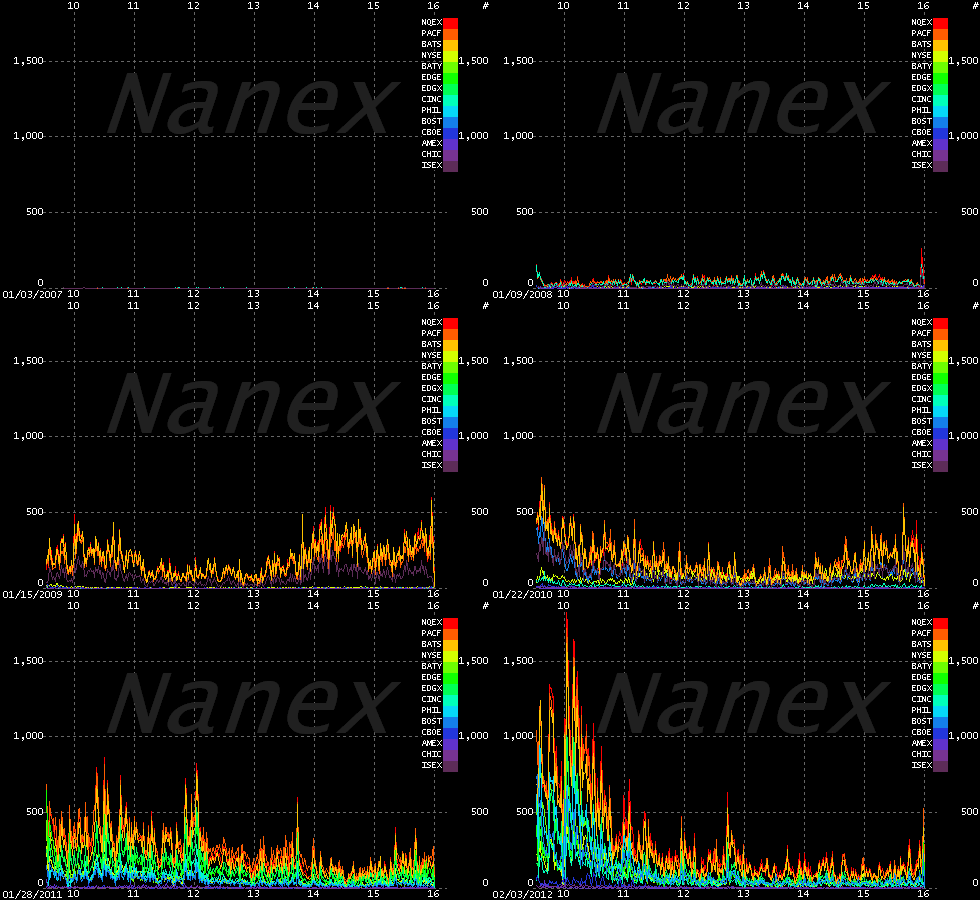
The growth in HFT over the past five years is simply incredible. Kevin Drum offers some interesting notes regarding what he calls “Algobot Wars”:
The basic idea behind HFT is that humans are taken out of the trading equation entirely. Instead, computer algorithms trade stocks directly, executing millions of trades per second and occasionally going crazy, as they did during the Flash Crash of 2010 and then again a few days ago, when an HFT bug cost Knight Capital $440 million in 30 minutes.
He goes on to note that UNX moved from Burbank to New York in order to gain 35 milliseconds in their algobot trades. Ironically, the increased speed actually hurt their bottom line, requiring them to slow down their programs. But what’s really spooky is that they don’t know why.
J. Keith Johnson’s Austrian and libertarian perspectives on current socioeconomic and geopolitical affairs are fueled by his insatiable desire to both discover and share the truth. A Goldco Direct affiliate, you’ll find his commentary on The Gold Informant website, as well as various Internet financial and news sites.